In a stand mixer bowl, combine the strong flour and fresh yeast.
Start the mixer on low and gradually add the milk and water.
Once a rough dough forms, add the sugar and salt.
Knead the dough for a couple of minutes on low speed, then for about 5-7 minutes on a higher speed until it becomes smooth and elastic.
Transfer the dough to a baking sheet lined with parchment paper, flatten it slightly, and cover it tightly with plastic wrap.
Let the dough rest at room temperature for about 30 minutes, then place it in the refrigerator to rest overnight.
On a piece of parchment paper, draw a 20x40 cm rectangle to use as a guide.
Fold the parchment paper along the drawn lines to create an envelope. Place the softened butter inside.
Close the parchment paper envelope and use a rolling pin to spread the butter evenly into a 20x40 cm block.
Place the butter block in the refrigerator overnight to firm up.
The next morning, take the chilled dough and butter block out of the fridge. On a floured surface, roll the dough into a 40x40 cm square.
Place the butter block in the center of the dough. Fold the sides of the dough over the butter to completely enclose it, sealing the edges firmly.
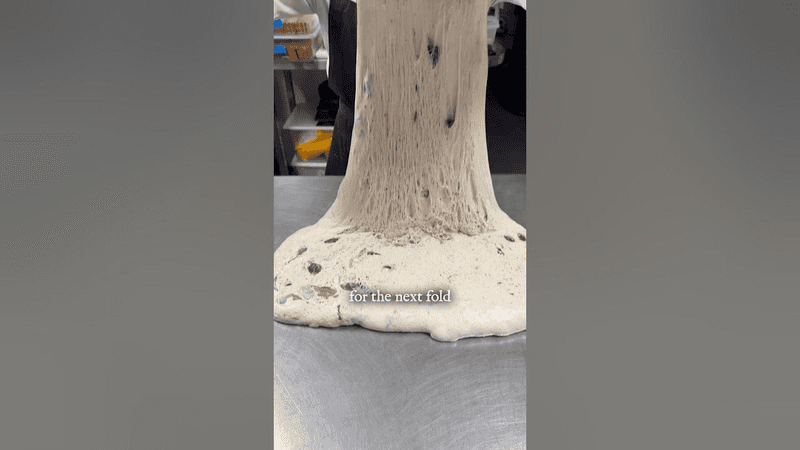
Roll the dough into a long rectangle (about 60 cm). Perform a '3-fold' by folding one-third of the dough to the center, then folding the opposite third over it.
Wrap the folded dough in plastic wrap and rest it in the freezer for 20 minutes.
Repeat the process: rotate the dough 90 degrees, roll it out again, and perform another 3-fold. This is the second fold.
Wrap and rest the dough in the freezer for another 20 minutes.
Perform the third and final 3-fold. After this fold, let the dough rest in the freezer for a final 20 minutes.
After the final rest, roll the dough into a large rectangle, approximately 60 cm long and 28 cm wide.
Trim the uneven edges of the dough with a pizza cutter or knife to create a clean rectangle.
To create the triangles, make incisions on the bottom edge every 10 cm. On the top edge, make the first incision at 5 cm, and then every 10 cm after that. Cut diagonally between the marks to form triangles.
Take a triangle, make a small cut at the base, gently stretch the dough, and roll it up from the base to the tip to form the croissant shape.
Place the shaped croissants on a baking sheet lined with parchment paper, ensuring they are well-spaced.
Allow the croissants to proof in a warm environment (24-26°C) for 2 to 2.5 hours, until they have visibly puffed up and doubled in size.
While the croissants proof, prepare a sugar syrup by boiling equal parts sugar and water. Also, prepare an egg wash by whisking an egg yolk with a splash of milk.
Preheat your oven to 180°C. Once proofed, gently brush the croissants with the egg wash.
Bake for about 15-20 minutes, or until the croissants are deep golden brown and well-risen.
Immediately after removing the croissants from the oven, brush them with the prepared sugar syrup for a beautiful shine.
Transfer the croissants to a wire rack to cool for at least 30 minutes before serving.
Nutrition data is AI-estimated and may not be fully accurate.

This recipe was created by analyzing the video with AI. For full details, please refer to the original video.